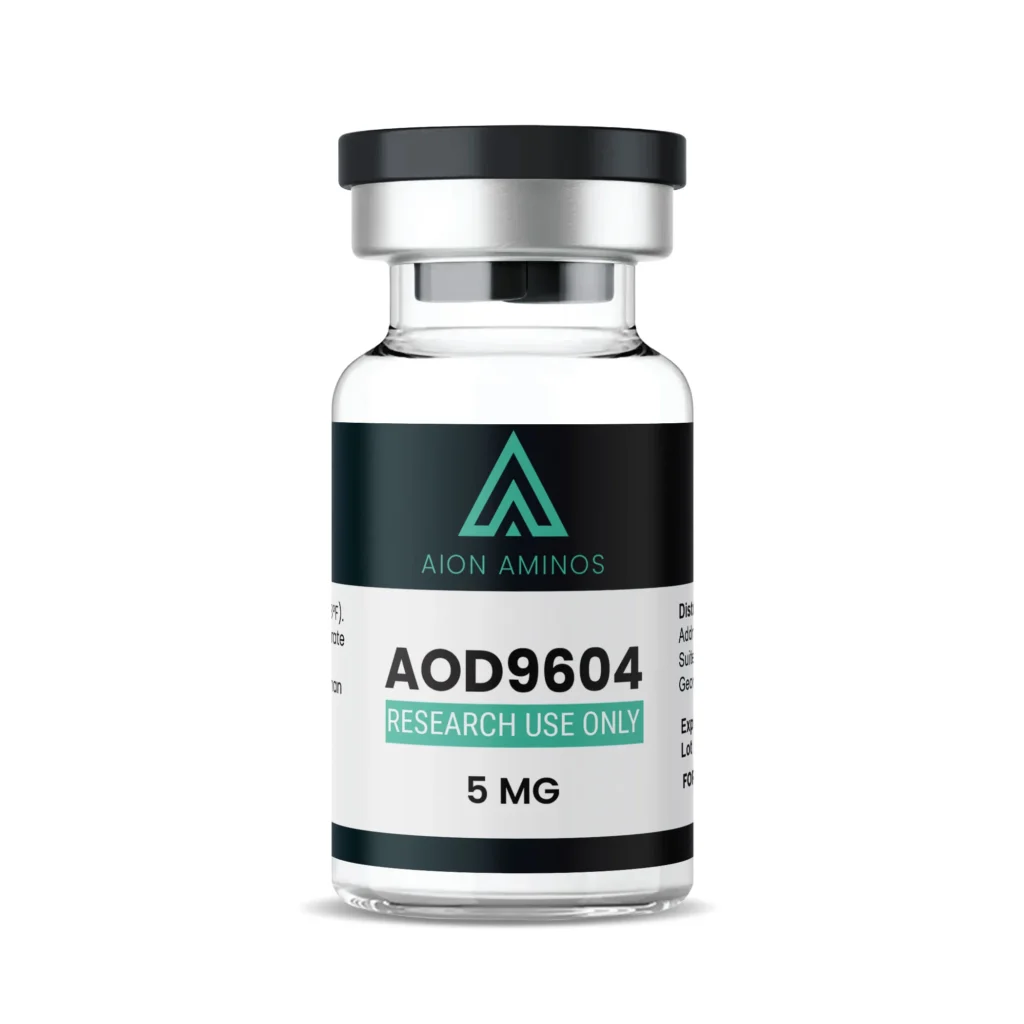
AOD-9604 is a synthetic 16-amino-acid peptide modeled on the C-terminal end of human growth hormone (hGH): residues 177 to 191 with an added tyrosine at the front. It was developed to study the fat-metabolism activity of growth hormone separately from its growth-promoting effects. This overview covers its structure, the lipid metabolism research behind it, what the human trials found and how to handle it in the lab.
The Aion Aminos AOD-9604 is supplied as a lyophilized powder for laboratory research use only. It is not a drug, supplement or cosmetic, and it is not intended for human or animal use.
What Is AOD-9604?
Human growth hormone is a 191-amino-acid protein. In the early 1990s, researchers at Monash University in Melbourne, led by Frank Ng, found that a synthetic copy of its last 15 residues (177 to 191) reproduced some of the hormone's effects on fat cells in rat models. Melbourne company Metabolic Pharmaceuticals then added a tyrosine to the N-terminus to make a more stable molecule and named it AOD-9604.
Because the added tyrosine sits where residue 176 would be in the native hormone, research catalogs often label the same sequence "hGH Fragment 176-191." The literature usually writes it as Tyr-hGH177-191.
Key facts
- Sequence: YLRIVQCRSVEGSCGF (Tyr-hGH177-191)
- Length: 16 amino acids
- Molecular weight: about 1.8 kDa
- Structure: one disulfide bond between the two cysteines
- Parent protein: human growth hormone (191 amino acids, about 22 kDa)
- Developed by: Monash University and Metabolic Pharmaceuticals, Australia
AOD-9604 in Lipid Metabolism Research
Early fragment studies
In 1993, Wu and Ng reported that synthetic hGH 177-191 reduced lipogenesis (fat synthesis) in rat fat tissue, matching an effect of the intact hormone. Follow-up work looked at lipolysis (fat breakdown) and at acetyl-CoA carboxylase, an enzyme in fatty acid synthesis.
Animal models
A 2000 study in Hormone Research by Ng and colleagues reported that AOD-9604 reduced weight gain in obese Zucker rats without impairing insulin sensitivity. A 2001 study in Endocrinology by Heffernan and colleagues compared AOD-9604 with intact hGH in obese mice and in mice lacking the beta-3 adrenergic receptor, and linked part of its effect on fat metabolism to that receptor pathway.
Separation from growth effects
The idea behind AOD-9604 was to keep the fat-metabolism signal while avoiding the growth-promoting and blood sugar effects of the full hormone. Published safety analyses of the human studies reported no change in IGF-1 levels, consistent with that goal. These are research findings, not established effects.
What the Human Trials Found
Metabolic Pharmaceuticals ran several human studies in the early 2000s, including oral Phase 2a safety work and two oral Phase 2b obesity trials. A 12-week trial reported in 2004 was presented as positive. The larger 24-week Phase 2b trial, with 536 participants, did not show significant weight loss compared with placebo, and development as an obesity drug ended in 2007.
Later research shifted to other areas, including preclinical cartilage work such as a 2015 rabbit osteoarthritis model study by Kwon and Park. AOD-9604 is not approved as a medicine by the FDA or Australia's TGA.
AOD-9604 vs Human Growth Hormone
| AOD-9604 | Human growth hormone |
|---|
| Length | 16 amino acids | 191 amino acids |
| Approx. mass | about 1.8 kDa | about 22 kDa |
| Origin | Synthetic, based on hGH residues 177 to 191 | Natural pituitary hormone |
| IGF-1 in published studies | No change reported | Raises IGF-1 |
| Research focus | Lipid metabolism, cartilage models | Growth, metabolism, many tissues |
Handling AOD-9604 in the Lab
- Store lyophilized vials cold and away from light, as directed on the label.
- Reconstitute with a preserved diluent such as Reconstitution Solution. Add it slowly down the side of the vial and swirl gently; vigorous shaking can stress the disulfide-bonded structure.
- Record the volume added so the concentration is known for every later withdrawal.
- Keep reconstituted material refrigerated and avoid repeated freeze and thaw cycles.
See our reconstitution lab guide for step-by-step technique and our 10 mL vs 30 mL guide to choose a diluent size.
Verifying Identity: Read the COA
On an AOD-9604 certificate of analysis, the mass spectrometry result should match the expected mass of about 1.8 kDa, and HPLC should show a single main peak with the reported purity. Our guide on how to read a peptide certificate of analysis explains each section.
AOD-9604 for laboratory research
Lyophilized research peptide with third-party lab testing. For research use only.
Frequently Asked Questions
Is AOD-9604 the same as hGH Fragment 176-191?
In practice, yes. Both names usually refer to the same 16-amino-acid sequence, YLRIVQCRSVEGSCGF. AOD-9604 is the original development name.
Is AOD-9604 a growth hormone?
No. It is a short fragment based on the end of the growth hormone molecule. It is far smaller than hGH, and published studies did not report the IGF-1 increase seen with the full hormone.
Is AOD-9604 approved as a drug?
No. Its obesity development program ended after the 24-week Phase 2b trial, and it is not an approved medicine. Research-grade AOD-9604 is for laboratory research only.
What is AOD-9604 studied for?
Mainly lipolysis and lipogenesis in fat cell and animal models, and more recently cartilage in preclinical models.
References
- Wu Z, Ng FM. Antilipogenic action of synthetic C-terminal sequence 177-191 of human growth hormone. Biochem Mol Biol Int. 1993.
- Ng FM, et al. Metabolic studies of a synthetic lipolytic domain (AOD9604) of human growth hormone. Horm Res. 2000.
- Heffernan MA, et al. The effects of human GH and its lipolytic fragment (AOD9604) on lipid metabolism following chronic treatment in obese mice and beta(3)-AR knock-out mice. Endocrinology. 2001.
- Stier H, Vos E, Kenley D. Safety and tolerability of the hexadecapeptide AOD9604 in humans. J Endocrinol Metab. 2013.
- Kwon DR, Park GY. Effect of intra-articular injection of AOD9604 with or without hyaluronic acid in rabbit osteoarthritis model. Ann Clin Lab Sci. 2015.