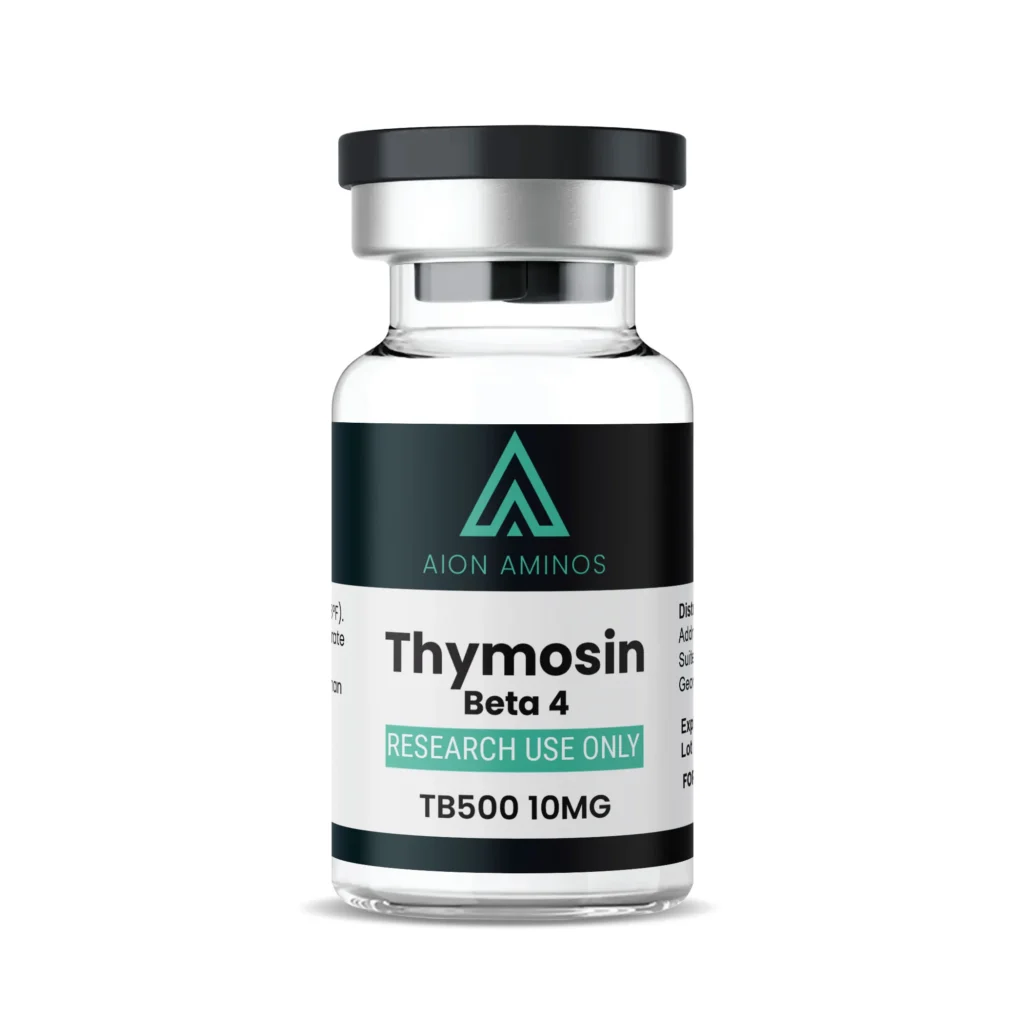
Thymosin beta 4 (Tβ4) is a naturally occurring 43-amino-acid peptide found in nearly every nucleated mammalian cell. It is the main intracellular buffer of monomeric actin, and researchers study it in preclinical models of cell migration, blood vessel formation and tissue repair. This overview covers its structure, how it behaves in research models, what the published literature does and does not show, and how it differs from the TB-500 fragment.
The Aion Aminos Thymosin Beta 4 is supplied as a lyophilized powder for laboratory research use only. It is not a drug, supplement or cosmetic, and it is not intended for human or animal use.
What Is Thymosin Beta 4?
Thymosin beta 4 was first isolated from a calf thymus extract known as thymosin fraction 5 and was fully sequenced in 1981 by Low, Hu and Goldstein. Despite the name, it is not specific to the thymus. It is the most abundant member of the beta-thymosin family and is present at high levels in platelets, white blood cells and many other tissues, as well as in fluids such as tears, saliva and wound fluid.
In 1991, Safer, Elzinga and Nachmias showed that Tβ4 is identical to an actin-sequestering factor previously isolated from platelets. That finding established its core job inside the cell: holding a reserve of unpolymerized actin that can be released when the cytoskeleton needs to rebuild.
Key facts
- Length: 43 amino acids
- Molecular weight: about 4.9 kDa
- N-terminus: acetylated serine (Ac-Ser)
- Gene: TMSB4X, on the X chromosome
- Family: beta-thymosins (with thymosin beta 10 and beta 15)
- Actin-binding motif: LKKTETQ, residues 17 to 23
How Thymosin Beta 4 Works in Research Models
Actin sequestering
Tβ4 binds monomeric G-actin in a one-to-one complex, which keeps actin from polymerizing until the cell needs it. Because cell shape, movement and division all depend on actin remodeling, this buffering role is the starting point for most of the research on Tβ4. The central actin-binding region, LKKTETQ, is the sequence most often discussed in structure and fragment studies.
The Ac-SDKP fragment
When Tβ4 is processed outside the cell, enzymes including meprin alpha and prolyl oligopeptidase can release its first four residues as the tetrapeptide N-acetyl-Ser-Asp-Lys-Pro (Ac-SDKP). Ac-SDKP has its own literature as an antifibrotic and pro-angiogenic signal in animal and cell models, so some effects attributed to Tβ4 in the literature may run through this fragment.
Cell signaling
Beyond actin, Tβ4 has been reported to influence integrin-linked kinase (ILK) and Akt signaling. A 2004 study in Nature by Bock-Marquette and colleagues described Tβ4 activating ILK and promoting cardiac cell migration and survival in mouse models. Other cell studies have looked at inflammatory signaling, including NF-kB activity. These are model findings and should be read as research leads, not established effects.
What the Published Literature Covers
Preclinical work on Tβ4 spans dermal wound models, corneal injury models and cardiac injury models. A 2005 review in Trends in Molecular Medicine by Goldstein, Hannappel and Kleinman summed up this body of work by describing Tβ4 as an actin-sequestering protein that also appears to take part in tissue repair.
The most developed clinical program used a pharmaceutical eye drop (RGN-259, 0.1% Tβ4). Phase 2 and Phase 2/3 studies looked at dry eye, and a Phase 3 study published in 2023 in the International Journal of Molecular Sciences reported complete healing at four weeks in 6 of 10 treated patients with neurotrophic keratopathy, compared with 1 of 8 on placebo. That difference was a trend rather than statistically significant at four weeks (p = 0.0656). Thymosin beta 4 is not approved by the FDA for any use.
These trials used controlled pharmaceutical formulations under clinical protocols. Their results describe those products in those settings and should not be generalized to research-grade material.
Thymosin Beta 4 vs TB-500
The two names are often used as if they were the same thing, but in the literature they are not. Thymosin beta 4 is the full 43-amino-acid peptide. “TB-500” is a name used in the research market for a synthetic peptide based on the actin-binding region of Tβ4, most often the short acetylated sequence Ac-LKKTETQ. Suppliers do not always use the term the same way, which is why the certificate of analysis matters.
| Thymosin beta 4 | TB-500 (fragment) |
|---|
| Length | 43 amino acids | Usually 7 amino acids (Ac-LKKTETQ) |
| Approx. mass | about 4.9 kDa | under 1 kDa |
| Origin | Naturally occurring peptide | Synthetic fragment of the actin-binding region |
| Literature | Decades of preclinical work plus clinical trials of RGN-259 | Mostly preclinical and analytical |
| How to tell them apart | Mass spectrometry on the COA | Mass spectrometry on the COA |
Handling Thymosin Beta 4 in the Lab
- Store lyophilized vials as directed on the label, cold and away from light.
- Reconstitute with a preserved diluent such as Reconstitution Solution, adding it slowly down the side of the vial and swirling gently rather than shaking.
- Record the volume added so the concentration is known for every later withdrawal.
- Keep reconstituted material refrigerated and avoid repeated freeze and thaw cycles.
Our reconstitution lab guide walks through each step, including concentration math.
Verifying Identity: Read the COA
Because full-length Tβ4 and the TB-500 fragment differ in mass by roughly a factor of five, mass spectrometry on a certificate of analysis is the quickest way to confirm what a vial contains. Check that the observed mass matches the expected mass for the peptide named on the label, and that HPLC purity is reported with a clear chromatogram. Our guide on how to read a peptide certificate of analysis explains each section.
Thymosin Beta 4 for laboratory research
Lyophilized research peptide with third-party lab testing. For research use only.
Frequently Asked Questions
Is thymosin beta 4 the same as TB-500?
No. Thymosin beta 4 is the full 43-amino-acid peptide, while TB-500 usually refers to a short synthetic fragment based on its actin-binding region. Mass spectrometry tells them apart.
Is thymosin beta 4 FDA approved?
No. Pharmaceutical forms of Tβ4 have been studied in clinical trials, but it is not approved for any use. Research-grade Tβ4 is for laboratory research only.
What is thymosin beta 4 studied for?
Mainly actin dynamics, cell migration, blood vessel formation and tissue repair in cell and animal models, plus clinical research on eye drop formulations.
Where is thymosin beta 4 found naturally?
In almost all nucleated mammalian cells, with especially high levels in platelets and white blood cells, and in body fluids such as tears and saliva.
References
- Low TL, Hu SK, Goldstein AL. Complete amino acid sequence of bovine thymosin beta 4. Proc Natl Acad Sci USA. 1981.
- Safer D, Elzinga M, Nachmias VT. Thymosin beta 4 and Fx, an actin-sequestering peptide, are indistinguishable. J Biol Chem. 1991.
- Bock-Marquette I, et al. Thymosin beta4 activates integrin-linked kinase and promotes cardiac cell migration, survival and cardiac repair. Nature. 2004.
- Goldstein AL, Hannappel E, Kleinman HK. Thymosin beta4: actin-sequestering protein moonlights to repair injured tissues. Trends Mol Med. 2005.
- Sosne G, Ousler GW. Thymosin beta 4 ophthalmic solution for dry eye: a randomized, placebo-controlled, Phase II clinical trial. Clin Ophthalmol. 2015.
- Sosne G, et al. 0.1% RGN-259 (thymosin ß4) ophthalmic solution promotes healing and improves comfort in neurotrophic keratopathy patients in a randomized, placebo-controlled, double-masked Phase III clinical trial. Int J Mol Sci. 2023;24(1):554.