Why a Certificate of Analysis Matters
A certificate of analysis (COA) is the document that shows what a laboratory found when it tested a specific batch of a compound. For research peptides, it is the main way to confirm three things before an experiment starts:
- Identity: Is this the peptide on the label?
- Purity: How much of the material is the target peptide, rather than related impurities?
- Quantity: Does the vial contain the amount stated on the label?
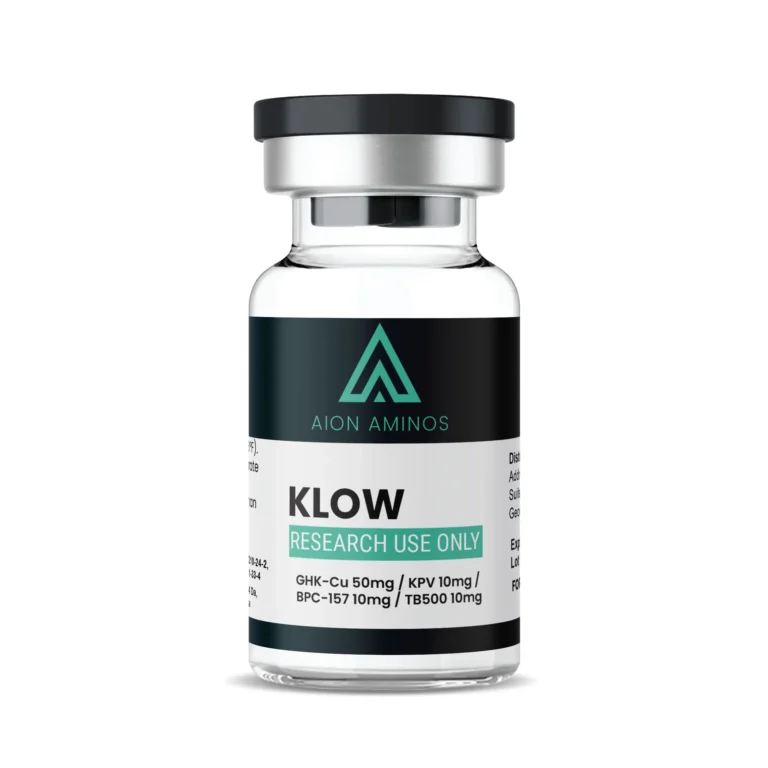
A study is only as reliable as the materials that go into it, so knowing how to read a COA is a basic research skill. Aion Aminos posts certificates of analysis on product pages so researchers can check this information before ordering.
The Parts of a Typical COA
- Header: The testing laboratory’s name and contact details.
- Product details: Compound name, labeled amount (for example 10 mg) and a batch, lot or sample identifier.
- Test date: When the analysis was carried out.
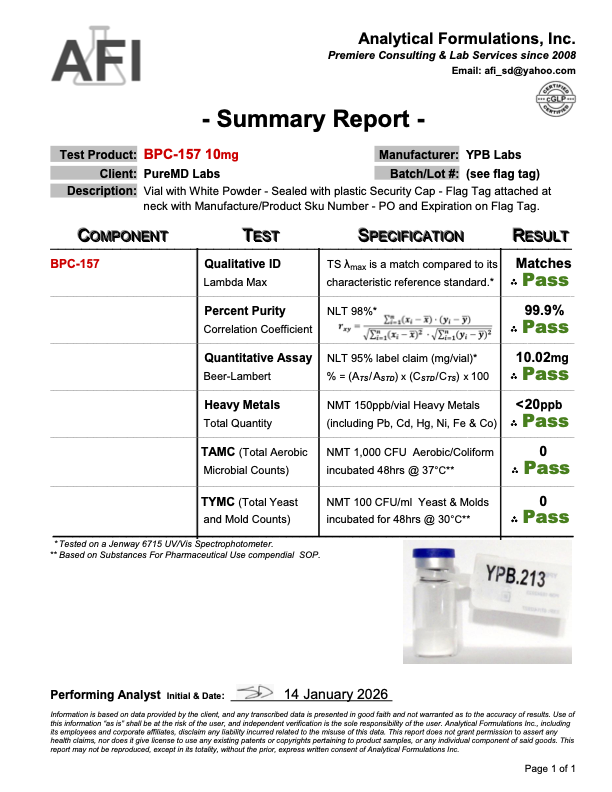
- Results table: Each test, its method, the specification (the pass limit) and the result.
- Notes: Instrument details, references to standard methods and sometimes a photo of the tested sample.
The batch identifier is important. A COA describes one specific batch, so researchers should be able to match it to the material they receive.
HPLC: Measuring Purity
High performance liquid chromatography (HPLC) is the most widely used method for measuring peptide purity. The sample is pushed through a column under high pressure. Different molecules travel through the column at different speeds and come out at different times, which are recorded as peaks on a chart called a chromatogram.
How to read it:
- Main peak: The largest peak should be the target peptide.
- Retention time: The time at which the main peak appears. It should match a reference standard run under the same conditions.
- Purity percentage: The area of the main peak divided by the total area of all peaks. A result of 99% means about 99% of the detected material is the target peptide.
- Small extra peaks: These are impurities, often shorter or modified versions of the peptide left over from synthesis.
HPLC purity tells you how clean the sample is, but on its own it does not prove the main peak is the right molecule. That is where mass spectrometry helps.
Mass Spectrometry: Confirming Identity
Mass spectrometry (MS) measures the mass of molecules in a sample. Because every peptide has a known molecular weight, the measured mass is strong evidence of identity.
- Expected mass: The theoretical molecular weight calculated from the peptide’s sequence.
- Observed mass: What the instrument measured. It should closely match the expected mass.
- Charge states: Peptides often appear as several peaks with different charges (for example [M+2H]2+). These are normal and are used to work out the true mass.
When a COA combines HPLC and MS (often as LC-MS), it shows both that the sample is pure and that the main component is the correct peptide.
UV-Vis Spectrophotometry
Some laboratories use UV-Vis spectrophotometry, which measures how a sample absorbs ultraviolet and visible light. Results you may see include:
- Qualitative ID (lambda max): The wavelength of strongest absorbance is compared with a reference standard. A match supports identity.
- Purity by correlation: The full absorbance spectrum of the sample is compared with the reference, and the similarity is reported as a percentage.
- Quantitative assay (Beer-Lambert): Absorbance is used to calculate how much peptide is in the vial, reported in mg and checked against the label claim.
UV-Vis is fast and well suited to checking amount per vial. It is less able than HPLC to separate closely related impurities, and less specific than MS for identity, so it is useful to know which method produced each number.
Assay: Is the Amount Right?
The assay, or quantitative content, tells you how much peptide is actually in the vial. A typical specification is not less than 95% of the label claim. For example, a 10 mg vial with a measured content of 10.02 mg meets that specification.
Purity and assay are different measurements. A sample can be very pure but slightly under-filled, or correctly filled but with more impurities. A good COA reports both.
Safety and Contaminant Testing
- Heavy metals: Tests for elements such as lead, cadmium, mercury, nickel, iron and cobalt, usually reported in parts per billion against a maximum limit.
- TAMC (total aerobic microbial count): The number of bacterial colonies grown from the sample, in colony forming units (CFU).
- TYMC (total yeast and mold count): The same idea for yeasts and molds.
- Endotoxin: Some COAs include bacterial endotoxin testing, reported in EU per mg.
Results of 0 CFU, or values well below the stated limit, indicate the sample passed these checks.
Reading the Results Table
Most COAs present each test in four columns: component, test, specification and result. Read across each row and ask:
- What was tested, and by which method?
- What was the pass limit (for example NLT 98% purity, where NLT means not less than, or NMT 150 ppb heavy metals, where NMT means not more than)?
- Did the result meet that limit?
Red Flags to Watch For
- No batch, lot or sample identifier
- No testing laboratory named, or no way to contact it
- Purity reported without the method used
- Identity claimed without any identity test
- A COA that is very old compared with the batch on sale
- Numbers that look edited, or the same report reused for different products
Where to Find Aion Aminos COAs
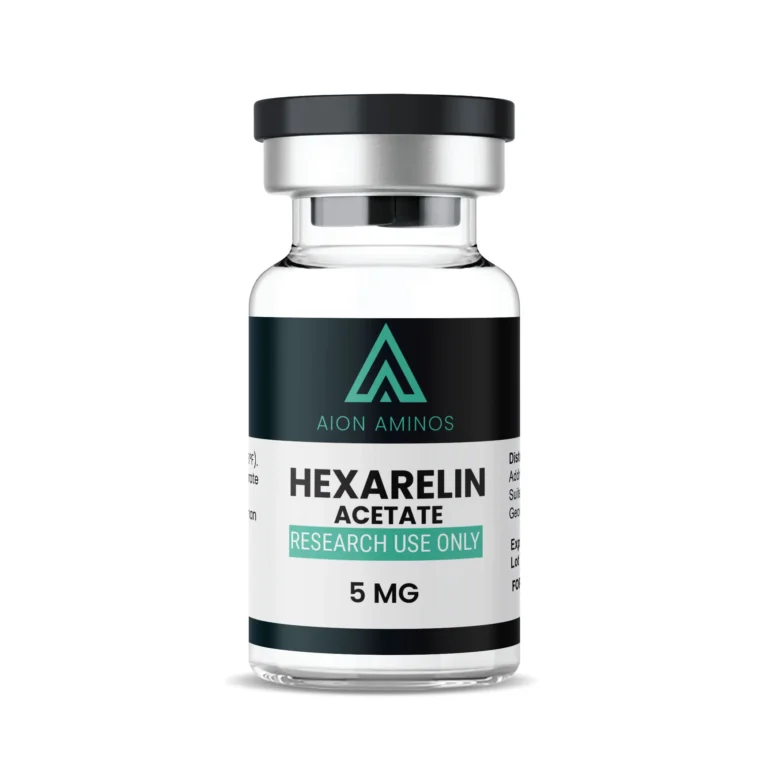
Certificates of analysis are shown in the image gallery on each product page. For example, see BPC-157, Hexarelin Acetate or MOTS-c. If you need the COA for a specific batch, contact our team.
Summary
A peptide COA answers three questions: is it the right compound, how pure is it, and is the amount correct. HPLC is the standard tool for purity, mass spectrometry confirms identity, and UV-Vis is often used for identity screening and amount per vial. Reading the method, specification and result for each test, and checking the batch identifier, lets researchers judge the quality of their materials before work begins.
Research Use Only Statement
All Aion Aminos products are sold strictly for laboratory research use only. They are not intended for human or animal use and are not drugs, foods, supplements or cosmetics.