What Is the KLOW Peptide Blend?
KLOW is a four-component research blend that combines GHK-Cu, BPC-157, TB-500 and KPV in a single lyophilized vial. The name follows the earlier GLOW blend (GHK-Cu, BPC-157 and TB-500), with the K standing for KPV, a short anti-inflammatory tripeptide added to the original three.
Each component has its own body of preclinical literature. Researchers interested in tissue signaling, extracellular matrix biology and inflammatory pathways often study them side by side, which is the main reason blended formats exist. This article walks through each component, the pathways it is studied in, and the limits of the current evidence.
The Aion Aminos KLOW Blend is supplied as a lyophilized powder for laboratory research use only. It is not a drug, supplement or cosmetic, and it is not intended for human or animal use.
KLOW Blend Composition
Each Aion Aminos KLOW vial is labeled with the following amounts:
- GHK-Cu: 50 mg
- BPC-157: 10 mg
- TB-500 (thymosin beta-4 fragment): 10 mg
- KPV: 10 mg
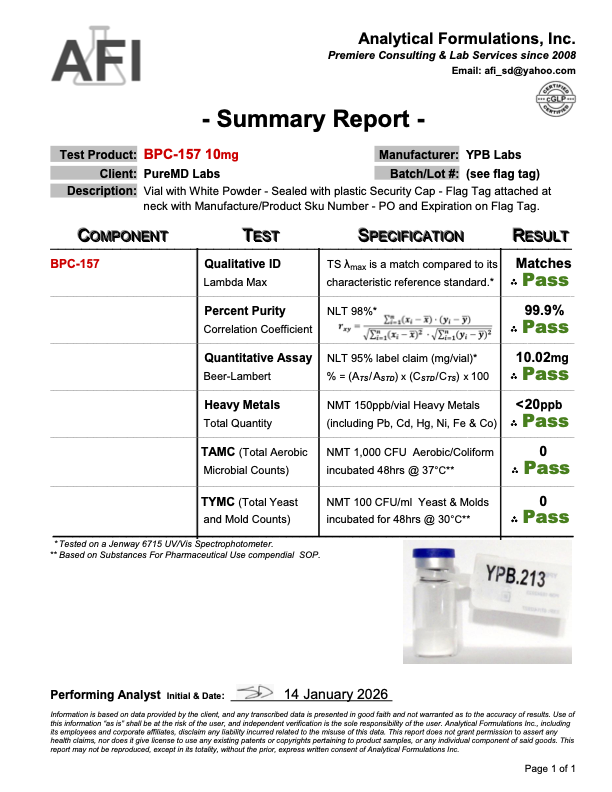
Because the components differ in size and charge, a blended vial behaves differently from four separate vials during analysis. Identity and purity testing for a blend has to resolve each component, which is one reason researchers should always check the certificate of analysis that applies to the specific lot they receive. Our guide on how to read a peptide certificate of analysis explains what to look for.
Component 1: GHK-Cu
GHK is a naturally occurring tripeptide (glycyl-L-histidyl-L-lysine) first isolated from human plasma in the early 1970s. It has a strong affinity for copper(II) ions, and the copper complex, GHK-Cu, is the form most often used in research.
Laboratory work on GHK-Cu has focused on:
- Fibroblast activity and collagen and elastin synthesis in cell culture
- Remodeling of the extracellular matrix, including metalloproteinase activity
- Gene expression profiling, where GHK has been reported to shift the expression of large sets of genes in cultured cells
- Copper transport and antioxidant signaling
Much of this work is in vitro or in skin and wound models. You can read more on the GHK-Cu product page.
Component 2: BPC-157
BPC-157 is a synthetic 15 amino acid peptide based on a fragment of a protein found in gastric juice, often called body protection compound. It has been studied mainly in rodent models over the last three decades.
Published preclinical studies have looked at BPC-157 in relation to:
- Angiogenesis signaling, including VEGFR2 pathways
- Nitric oxide system interactions
- Tendon, ligament, muscle and gastrointestinal tissue models
- Fibroblast migration and outgrowth in culture
Most of the BPC-157 literature comes from a small number of research groups, and controlled human data remain very limited. For a side by side comparison with TB-500, see BPC-157 vs TB-500.
Component 3: TB-500
TB-500 is a synthetic peptide derived from thymosin beta-4 (Tβ4), a 43 amino acid protein found in most cell types. Tβ4 is one of the main actin-sequestering proteins in the cell, which means it helps regulate the pool of free actin available for building the cytoskeleton.
Research on Tβ4 and its fragments has examined:
- Cell migration and actin cytoskeleton organization
- Endothelial cell behavior and blood vessel formation in experimental models
- Wound, cardiac and corneal models in animals
Researchers should note that TB-500 is a fragment, not the full Tβ4 protein. Findings from full-length Tβ4 studies do not automatically apply to the fragment. See the Thymosin Beta-4 product page for specifications.
Component 4: KPV
KPV is a tripeptide (lysine, proline, valine) that matches the C-terminal end of alpha-melanocyte stimulating hormone (α-MSH). It is studied for its anti-inflammatory signaling without the pigment-related activity associated with the full α-MSH molecule.
Preclinical work on KPV has explored:
- NF-κB signaling and inflammatory cytokine expression in cell models
- Uptake through the PepT1 peptide transporter in intestinal epithelial cells
- Rodent models of intestinal inflammation
The addition of KPV is the main difference between KLOW and GLOW. More detail is on the KPV product page.
Why Study These Peptides Together?
Tissue repair research involves several overlapping processes: inflammation, cell migration, new blood vessel formation and matrix remodeling. Each KLOW component is studied in at least one of these areas:
- Inflammatory signaling: KPV
- Cell migration and cytoskeleton: TB-500
- Angiogenesis and nitric oxide pathways: BPC-157
- Collagen and matrix remodeling: GHK-Cu
A blended format lets researchers work with a fixed ratio of all four in one vial. It also introduces variables. Interactions between components, stability of the mixture and the effect of one component on the measurement of another are open questions that a well-designed study should account for. Researchers who need to isolate a single pathway may prefer individual compounds, such as BPC-157 on its own.
KLOW vs GLOW
GLOW combines GHK-Cu, BPC-157 and TB-500. KLOW contains the same three plus KPV. The practical difference for researchers is the added focus on inflammatory signaling. If a study design does not involve inflammation endpoints, the GLOW Blend may be the simpler choice. Our overview of GLOW in preclinical research models covers that blend in more depth.
What the Research Does Not Show
It is worth being clear about the limits of the evidence:
- There are no published controlled studies of the four-peptide KLOW combination itself. The literature describes the individual components.
- Most data come from cell culture and animal models. Results in those models do not establish effects in humans.
- None of the components is approved by the FDA as a drug for any use.
Any claims that KLOW treats, heals or cures a condition in people are not supported by the current research.
Laboratory Handling and Storage
KLOW is supplied as a lyophilized powder. General handling practice for lyophilized research peptides includes:
- Storing unopened vials cold and away from light, typically at -20°C for long-term storage
- Allowing the vial to reach room temperature before opening to limit condensation
- Reconstituting with an appropriate sterile diluent using aseptic technique
- Refrigerating reconstituted material at 2 to 8°C and avoiding repeated freeze and thaw cycles
For a full walkthrough, see our lab guide to reconstitution solution vs bacteriostatic water.
Summary
The KLOW peptide blend brings together four compounds that are each studied in a different part of tissue signaling research: GHK-Cu for matrix and collagen biology, BPC-157 for angiogenesis and nitric oxide pathways, TB-500 for actin and cell migration, and KPV for inflammatory signaling. The individual literatures are interesting but mostly preclinical, and the combination itself has not been studied as a unit. Researchers should treat it as a convenient format for multi-pathway work, verify each lot with its certificate of analysis, and design studies with the blend’s added variables in mind.
Research Use Only Statement
All Aion Aminos products, including the KLOW Blend, are sold strictly for laboratory research use only. They are not intended for human or animal consumption, and they are not drugs, foods, supplements or cosmetics. Nothing in this article is medical advice or a claim that any product diagnoses, treats, cures or prevents any disease.