
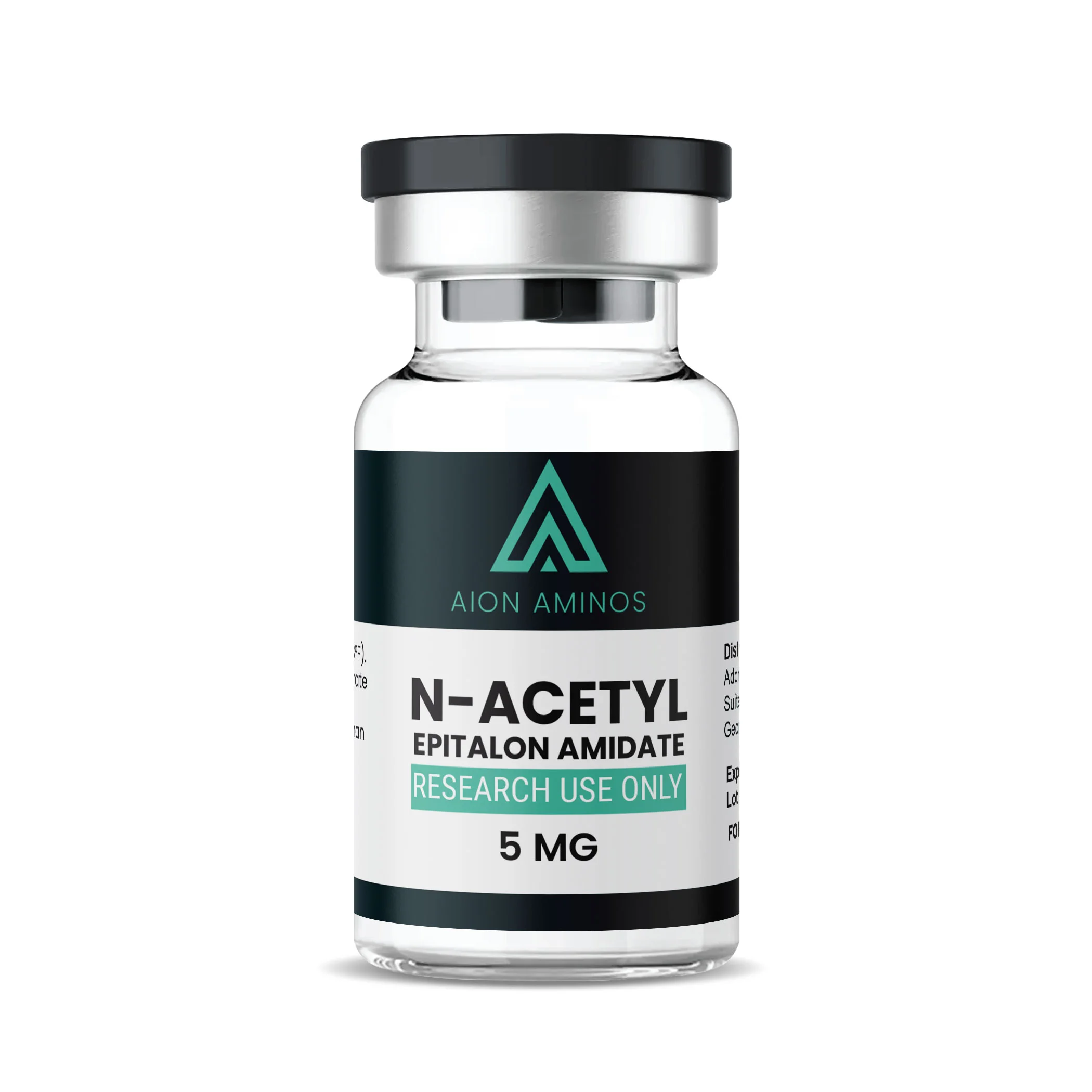
N-Acetyl Epitalon Amidate

$67.00

Out of stock

You’ll be briefly redirected to Link Money, our secure ACH payment partner, to connect your bank and complete payment.– Your bank login is never visible to or stored by us – Encrypted, bank-level security – A standard, trusted payment process
Aion Aminos

Precision Peptides for Advanced Research

N Acetyl Epitalon Amidate is a structurally modified analog of the tetrapeptide Epitalon. This variant, sometimes referenced as n acetyl epithalon amidate, features both N-terminal acetylation and C-terminal amidation, modifications designed to enhance stability in controlled laboratory environments. As a modified form of epitalon amidate, this compound is studied in vitro for its relevance to cellular aging, gene expression, and signaling pathways associated with the pineal gland. Derived from the well-known AEDG peptide sequence (four amino acids), this stabilized analog is investigated in experimental systems examining aging, circadian rhythm, epigenetic regulation, and telomere-related mechanisms. Research publications, including work by Vladimir Khavinson (V Khavinson) and collaborators such as Linkova N and V N Anisimov, have explored related peptides in academic settings associated with the St Petersburg Institute and other research centers. Studies indexed in scientific literature have examined mechanisms involving telomerase, telomerase activity, telomeres, and telomere length in cellular models, including human somatic cell systems. All references to these areas are limited strictly to laboratory investigation and research purposes. This product is supplied as a stable lyophilized powder for research applications.

Research Applications (Laboratory Use Only)

In controlled laboratory environments, epitalon amidate and its modified form, n acetyl epitalon amidate, are studied in cellular systems investigating aging, cellular aging, and regulatory pathways linked to the pineal gland. Research has explored peptide interaction with gene expression mechanisms and epigenetic signaling under experimental conditions.

Academic publications reference investigations into telomerase, telomerase activity, telomeres, telomere length, and models examining theoretical frameworks of telomere elongation in cultured cells, including human somatic cell systems. Research has also evaluated circadian-related mechanisms associated with the circadian rhythm and cellular signaling networks.

All such research remains confined to experimental laboratory contexts and does not represent approved clinical application.

Features & Chemical Makeup

  • Modified form of epitalon amidate

  • Also referenced as n acetyl epitalon and n acetyl epithalon amidate

  • Based on the tetrapeptide AEDG peptide sequence (4 amino acids)

  • Structurally stabilized via N-terminal acetylation and C-terminal amidation

  • Classified among synthetic research peptides

  • Studied in relation to aging, cellular aging, and cellular longevity pathways

  • Evaluated in experimental systems examining telomerase and telomerase activity

  • Investigated for research involving gene expression and pineal gland signaling

  • Research references include publications associated with Khavinson VK, V Khavinson, Linkova N, and V N Anisimov

  • Supplied as a laboratory-grade lyophilized powder

  • Molecular weight consistent with published specifications

  • Distributed for research purposes within the United States

  • Not a cosmetic, not a nasal spray, and not an approved epitalon treatment

Frequently Asked Questions

N Acetyl Epitalon Amidate is a modified version of the epitalon peptide, incorporating structural changes that enhance stability in research environments. It is studied in laboratory systems investigating aging, gene expression, and telomere-related cellular pathways.

No. This product is not approved as an epitalon treatment and is not intended for human consumption. It is supplied strictly for research purposes.

No. This is not a nasal spray and is not formulated for administration. It is provided as a lyophilized powder for laboratory research use only.

Scientific literature has explored telomerase, telomerase activity, and telomeres in experimental models involving epitalon-related peptides. These investigations are limited to laboratory research and do not imply therapeutic application.


More Peptides