Overview
Most research peptides are shipped as a lyophilized (freeze-dried) powder because peptides are far more stable dry than in solution. Before use in the lab, the powder has to be dissolved in a suitable liquid, a step called reconstitution. The choice of liquid, and how it is handled, affects sterility, stability and the accuracy of every measurement that follows.
This guide explains the common terms, compares the main diluent types, and sets out good practice for reconstituting and storing research peptides.
What Is Reconstitution Solution?
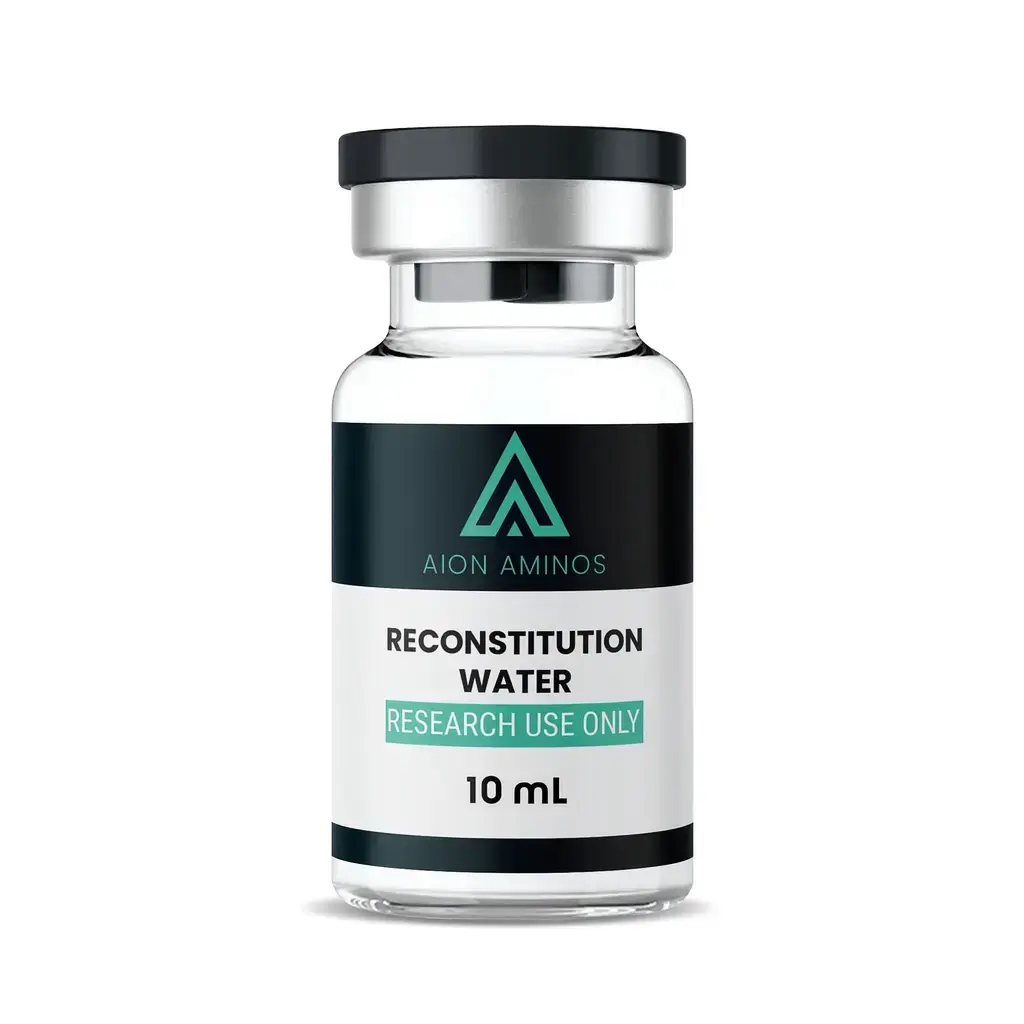
Reconstitution solution is a general term for a sterile liquid used to dissolve a lyophilized compound. The Aion Aminos Reconstitution Solution is sterile water containing 0.9% benzyl alcohol as a preservative, supplied in a sealed 10 mL glass vial for laboratory use.
What Is Bacteriostatic Water?
Bacteriostatic water is sterile water with 0.9% benzyl alcohol added. Benzyl alcohol does not kill all microorganisms, but it slows bacterial growth, which is what bacteriostatic means. This allows a vial to be punctured more than once under aseptic technique.
In practice, a reconstitution solution made with 0.9% benzyl alcohol and bacteriostatic water share the same basic formula. The difference is mostly in naming and labeling. The term reconstitution solution is used for products sold for laboratory research rather than for medical use.
Comparing Common Diluents
- Reconstitution solution / bacteriostatic water (0.9% benzyl alcohol): Preserved, suitable for multiple withdrawals from one vial. The most common general-purpose choice for peptide work.
- Sterile water: No preservative. Intended for a single use, because once the seal is broken there is nothing to slow microbial growth.
- Sodium chloride 0.9% (saline): Isotonic, sometimes used where salt content matters for the assay. Available with or without preservative.
- Dilute acetic acid: Used for some peptides that dissolve poorly at neutral pH. Researchers should check the solubility notes for the specific compound.
Benzyl alcohol can interact with some compounds or assays. If an experiment is sensitive to preservatives, sterile water or another preservative-free diluent may be the better choice.
Before You Start
- Work in a clean area, ideally a laminar flow hood or biosafety cabinet.
- Wear gloves and use sterile, single-use supplies.
- Let the peptide vial come to room temperature before opening. This reduces condensation, which can affect the powder.
- Confirm the amount of peptide in the vial from the label and the certificate of analysis.
Reconstitution Steps
- Disinfect both stoppers. Wipe the rubber stoppers of the peptide vial and the diluent vial with 70% isopropyl alcohol and let them air dry.
- Draw the diluent. Using a sterile syringe, withdraw the planned volume of reconstitution solution.
- Add slowly down the side of the vial. Let the liquid run down the inside wall rather than spraying it directly onto the powder. This limits foaming and mechanical stress on the peptide.
- Swirl gently. Roll or swirl the vial until the powder dissolves. Do not shake hard, since vigorous agitation can damage some peptides.
- Inspect. The solution should be clear. Cloudiness or particles may mean the peptide has not fully dissolved, the diluent is not suitable, or the material has degraded.
- Label the vial. Record the compound, concentration, diluent, date of reconstitution and your initials.
Calculating Concentration
Concentration is simply the mass of peptide divided by the volume of diluent added:
Concentration (mg/mL) = peptide mass (mg) ÷ diluent volume (mL)
For example, 5 mg of peptide dissolved in 2.0 mL of diluent gives 2.5 mg/mL. Choosing a volume that gives a round number makes later dilutions easier and reduces calculation errors.
Storage After Reconstitution
- Lyophilized (unopened): Store cold and away from light. -20°C is common for long-term storage.
- Reconstituted: Refrigerate at 2 to 8°C. Do not leave at room temperature for long periods.
- Avoid freeze and thaw cycles: If long-term storage of a solution is needed, divide it into single-use aliquots before freezing.
- Protect from light: Some peptides, including copper complexes such as GHK-Cu, are light sensitive.
- Diluent vials: After the first puncture, a preserved multi-dose vial is commonly discarded after 28 days, in line with general pharmacy practice for multi-dose containers.
Common Handling Mistakes
- Shaking the vial hard to speed up dissolving
- Opening a cold vial straight from the freezer
- Reusing needles or syringes between vials
- Not labeling the reconstitution date and concentration
- Using preservative-free sterile water for a vial that will be accessed many times
Frequently Asked Questions
Is reconstitution solution the same as bacteriostatic water?
When the reconstitution solution is sterile water with 0.9% benzyl alcohol, the formula is the same. The difference is in labeling and intended use. Aion Aminos Reconstitution Solution is sold for laboratory research use only.
What is reconstitution solution used for?
It is used to dissolve lyophilized research compounds, such as peptides, so they can be measured and used in laboratory experiments.
Can I use sterile water instead?
Sterile water works as a diluent, but because it has no preservative it is best for single-use preparations.
Summary
Reconstitution is a small step with a big effect on research quality. A preserved diluent such as reconstitution solution or bacteriostatic water suits most multi-use peptide work, while sterile water suits single-use preparations. Careful technique, accurate concentration records and cold, dark storage help keep reconstituted peptides stable and results reliable.
Research Use Only Statement
Aion Aminos Reconstitution Solution and all Aion Aminos peptides are sold strictly for laboratory research use only. They are not intended for human or animal use. This guide describes general laboratory practice and is not medical advice.