Product Overview
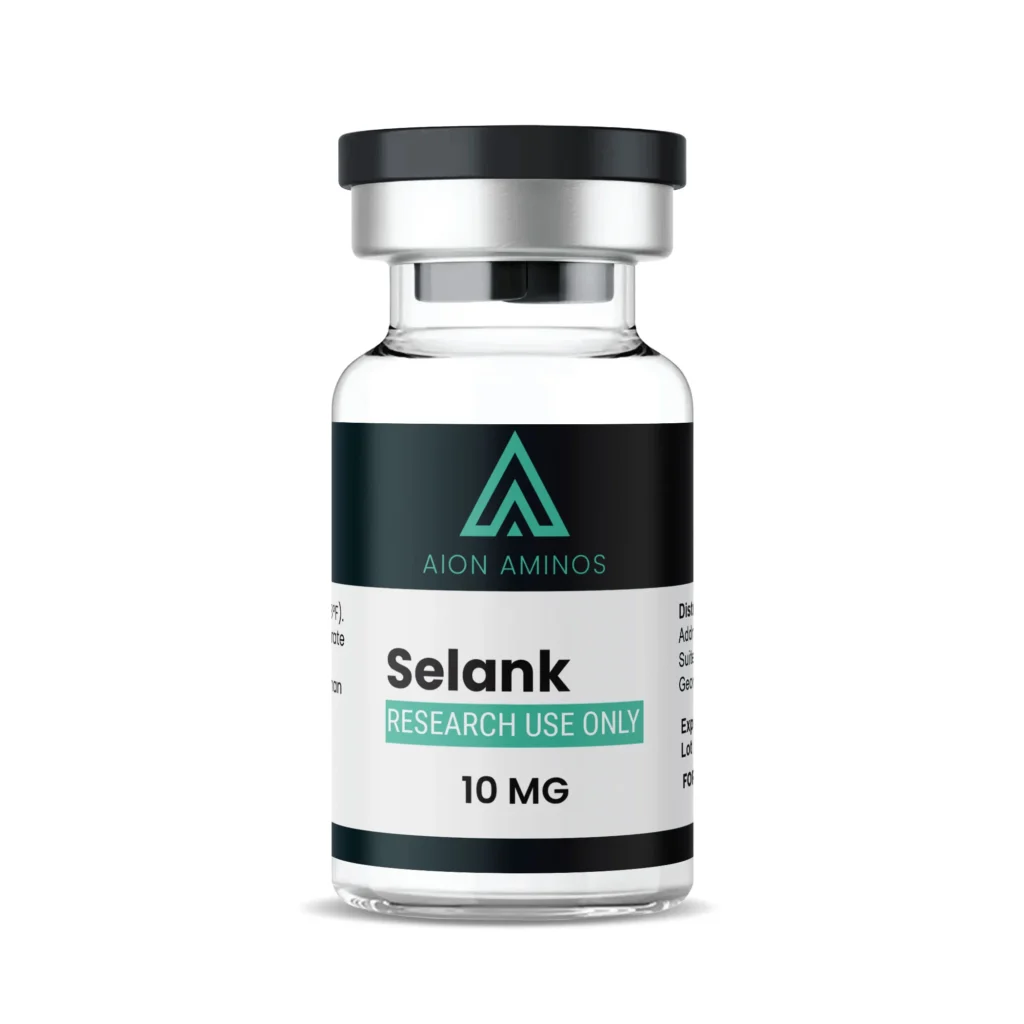
Selank is a synthetic peptide analog derived from tuftsin, a naturally occurring tetrapeptide involved in immune system signaling. The compound is supplied strictly as a research peptide for laboratory research and is not supplied in any consumer-ready format.
Selank has been examined in published laboratory research addressing neurotransmitter signaling pathways, neuroendocrine communication, and immune–neural regulatory interactions. Because the nervous system relies on complex signaling molecules to coordinate communication between neurons, compounds such as the Selank peptide are frequently investigated in experimental models exploring neuropeptide signaling, cognitive regulatory networks, and stress-response pathways.
Investigators studying neurobiology often examine peptides like Selank to characterize how neurotransmitter systems, immune signaling molecules, and neuroendocrine pathways interact within the central nervous system. Nothing on this page describes a use, benefit, or outcome in humans.
Origin and Development History
Selank was developed at the Institute of Molecular Genetics of the Russian Academy of Sciences, in collaboration with the Institute of Pharmacology of the Russian Academy of Medical Sciences. The Russian Academy research program that produced this compound also produced Semax, another synthetic peptide investigated in neuropeptide signaling literature.
Publications originating from that program describe the design rationale behind the molecule: modifying a short endogenous immune peptide to extend its stability in laboratory preparations while retaining measurable interactions with central nervous system signaling pathways. Much of the primary literature on Selank research was published in Russian-language journals and is available in translation, which is why terminology in secondary sources is inconsistent a point addressed in the terminology section below.
Molecular Structure and Composition
Selank is a synthetic heptapeptide composed of seven amino acids.
| Property | Value |
| Compound name | Selank |
| Classification | Synthetic peptide (heptapeptide) |
| Sequence | Thr-Lys-Pro-Arg-Pro-Gly-Pro |
| Amino acid count | 7 |
| Molecular formula | C33H57N11O9 |
| Molecular weight | ~751.9 g/mol |
| Parent molecule | Tuftsin (Thr-Lys-Pro-Arg) |
| Physical form | Lyophilized powder |
| Intended use | Laboratory research use only |
The heptapeptide Selank structure consists of the four amino acids of the tuftsin sequence extended by a Pro-Gly-Pro tripeptide fragment. This structural modification is described in the literature as a stabilizing addition, and it allows researchers to examine how peptide derivatives interact with neurotransmitter signaling and neuroendocrine communication pathways under laboratory conditions.
Tuftsin and Immune–Neural Communication
Tuftsin is a naturally occurring peptide derived from the Fc fragment of immunoglobulin G (IgG). It has been studied in research examining immune cell signaling and macrophage activation pathways, where it interacts with the neuropilin-1 receptor and related surface targets.
Because immune signaling molecules can interact with neural systems, tuftsin-derived peptides are often investigated in research exploring immune–brain communication networks. Selank was constructed as a modified analog of tuftsin so that investigators could examine how peptide signaling relates to central nervous system regulatory pathways in controlled models.
Mechanism of Action in a Research Context
In laboratory research, Selank has been studied for its interaction with several biological signaling systems associated with neurobiology. The following describes neutral mechanisms reported in the scientific literature. It does not describe an effect of this product in humans.
GABA Receptor and Ionotropic Signaling
A recurring focus of Selank research is the GABAergic system. Published work has examined how the peptide relates to GABA receptor binding characteristics and to the expression of receptor subunit genes in rodent brain tissue. Investigators use the GABA receptor as a reference point because it is a well-characterized inhibitory receptor system, which makes it a tractable target for modulation studies in experimental biology.
Monoamine Signaling Pathways
Research models have examined how Selank relates to signaling pathways involving:
- gamma-aminobutyric acid (GABA)
- serotonin signaling pathways, including turnover and metabolite ratios in brain tissue homogenates
- dopamine-related communication networks
- noradrenergic signaling
Each of these represents a measurement endpoint in an animal or cell model, not an outcome claim.
Gene Expression Studies
Several published studies have profiled changes in gene expression following Selank exposure in rodent models. Reported work includes expression analysis of genes associated with GABAergic signaling, interleukin genes linked to immune communication, and brain-derived neurotrophic factor. Expression profiling of this kind gives researchers a molecular readout for questions that behavioral models alone cannot answer, and the genes selected for analysis vary considerably between research groups.
Neuroendocrine Communication
The nervous system and endocrine system interact through complex regulatory networks. Neuropeptides such as Selank are studied in experimental models examining how signaling molecules relate to neuroendocrine regulatory pathways, including hypothalamic–pituitary–adrenal axis signaling.
Immune–Neural Signaling
Because Selank is derived from the immune peptide tuftsin, researchers have also examined its relationship to immune system signaling and neuroimmune communication. These investigations allow scientists to study how immune signaling molecules may relate to neural communication networks.
Anxiety-Related Behavior as a Research Endpoint
Much of the published Selank literature is organized around anxiety-related behavior in animal models. In this literature, “anxiety” refers to a set of standardized behavioral measurements elevated plus maze arm entries, open field exploration, light–dark box transitions and not to a human condition or a claim about one.
Researchers use these anxiety-related paradigms because they produce quantifiable, repeatable data. Study designs frequently compare a Selank-treated animal group against a control group and report differences in the behavioral scores that the anxiety model generates. Where a study reports an anxiolytic effect, that phrase describes the direction of a measured behavioral score within that specific model nothing more.
Because animal anxiety paradigms are proxies rather than direct analogs of human experience, the anxiety research literature treats these findings as hypothesis-generating. Terms such as anxiety reduction and anxiety relief appear in translated abstracts and secondary summaries of this work; they describe published study endpoints in animal research, not properties of this product, and no product sold here has been evaluated for any anxiety-related purpose in humans.
Sedation as a Separate Measured Variable
Sedation is tracked independently of anxiety-related scoring in this field, because a compound that suppresses general locomotor activity can produce anxiety-like scores that are artifacts rather than signal. Rodent protocols therefore pair anxiety paradigms with locomotor and motor-coordination assays specifically to detect sedation. Published Selank studies commonly report these sedation control measures alongside their primary behavioral data, and the distinction between a behavioral effect and a sedation artifact is one of the standing methodological questions in the anxiety-model literature.
Stress Response, Mood, and Emotional Regulation Research
Stress-response signaling is a second major research theme. Experimental designs commonly apply a controlled stress protocol to a rodent model and then measure downstream markers of the stress response, including corticosterone levels, monoamine turnover, and inflammatory signaling markers.
Related research vocabulary mood, emotional regulation, and emotional balance appears throughout this literature as shorthand for behavioral and neurochemical composites measured in animals. When a paper discusses mood-related endpoints, it is describing scored behavior and tissue chemistry in a model organism. The modulation of these measured signals under different experimental conditions is what the research is actually characterizing, and mood-related terminology should be read in that narrow methodological sense.
Stress and mood research using neuropeptides typically examines three layers together: acute stress response markers, longer-term expression changes, and behavioral scoring. This layered approach is standard in experimental biology because no single measure of a stress response is considered sufficient on its own.
Cognitive Signaling Research
A further body of Selank research examines cognitive signaling systems. In this context, cognitive function refers to measurable task performance in an animal model maze acquisition, object recognition, conditioned avoidance retention and cognitive performance is the scored output of those tasks.
Popular and secondary sources sometimes discuss this work using consumer-facing language such as cognitive enhancement or mental clarity. Those phrases do not appear as validated endpoints in the primary research and do not describe this product. Any mention of cognitive enhancement or mental clarity in connection with neuropeptides should be understood as informal shorthand in non-scientific writing, not as a demonstrated result and not as a representation about what this compound does in a person.
A Note on Terminology Found in Secondary Sources
Search results and translated abstracts contain a number of phrases that carry implications the primary literature does not support. Because researchers encounter these phrases when reviewing sources, they are defined here in their proper context:
- Selank therapy — This phrase appears in translated clinical-research abstracts and in popular articles. It refers to investigational protocols described in that published literature. It does not describe an approved therapy, and it does not describe any permitted use of this product, which is sold for laboratory research purposes only.
- Selank administration — In the primary literature this describes how a compound was introduced to a model organism under an approved animal-research protocol. It is a description of published study methodology. No administration guidance of any kind is provided with this product.
- Intranasal Selank — Published Russian studies frequently describe an intranasal route in their methods sections, and intranasal Selank is therefore a common phrase in the literature. This describes historical study design only.
- Spray formulations — Because of that route, secondary sources sometimes refer to a nasal spray. This product is not supplied as a spray, is not formulated as a spray, and is not packaged in any spray, dropper, or other ready-to-use delivery format. It is supplied as a lyophilized powder for laboratory use.
- Selank exposure — In cell-culture and animal studies, Selank exposure denotes the experimental condition applied to a model system, as distinct from a control condition.
Researchers reviewing this literature should note that translation artifacts and popular-press framing account for a substantial share of the therapeutic-sounding language attached to this compound online.
Neuropeptides and Brain Signaling
Neuropeptides are small protein molecules that act as signaling messengers within the nervous system. Unlike classical neurotransmitters, neuropeptides often regulate longer-lasting communication signals between neurons and act at lower concentrations across wider anatomical ranges.
These signaling molecules participate in several biological processes, including:
- stress response signaling
- behavioral regulatory pathways
- neuroendocrine communication
- immune–neural interactions
- receptor expression and downstream gene expression changes
Because neuropeptides participate in these systems, researchers study them to understand how the brain coordinates complex communication networks, and the modulation of neuropeptide signaling is an active question across multiple subfields.
Areas of Scientific Investigation
Research applications involving Selank span several biological systems associated with neuropeptide signaling. Documented areas of investigation include:
- neurotransmitter signaling pathways, including GABAergic and monoaminergic systems
- neuroendocrine communication networks
- neuroimmune signaling pathways
- cognitive signaling systems and learning-task models
- stress-response regulatory pathways
- gene expression and receptor subunit profiling
Much of this work has been conducted in cellular and animal models designed to investigate neurobiological signaling mechanisms. These research applications are laboratory research contexts only; none of them constitute evidence of safety or efficacy for any use outside a controlled laboratory research setting.
Selank vs Semax
Two peptides commonly compared in neuropeptide research are Selank and Semax.
| Selank | Semax | |
| Parent molecule | Tuftsin (IgG-derived immune peptide) | ACTH(4-10) fragment |
| Length | 7 amino acids | 7 amino acids |
| Common research focus | Neurotransmitter and neuroimmune signaling | Neurotrophic signaling pathways |
| Origin | Russian Academy of Sciences program | Russian Academy of Sciences program |
Researchers often examine both peptides in parallel to investigate how structurally distinct neuropeptide signaling molecules relate to brain communication networks.
Related Research Peptides
Investigators studying neuropeptide signaling frequently examine compounds that interact with complementary biological systems.
Semax — A synthetic peptide studied in experimental models examining neurotrophic signaling pathways.
DSIP (Delta Sleep Inducing Peptide) — Investigated in research examining sleep-related neuroendocrine signaling.
Melanocortin peptides — Studied in research examining neuroendocrine communication and central nervous system signaling.
Together, these compounds allow researchers to investigate multiple aspects of neural signaling biology. All are sold for laboratory research purposes only.
Handling, Storage, and Reconstitution
This section describes laboratory material handling. It contains no dosing, administration, or use guidance of any kind.
- Supplied as a lyophilized powder in a sealed vial.
- Store lyophilized material as indicated on the vial label; protect from light and moisture.
- Reconstitution solvent selection, concentration, aliquoting, and storage of reconstituted material are determined solely by the qualified researcher in accordance with their own institutional laboratory protocols.
- No reconstitution instructions, concentrations, volumes, schedules, or administration procedures are supplied with this product, and none will be provided on request.
- Each researcher is responsible for verifying compound identity and suitability for their own experimental design prior to laboratory research use, and for compliance with all applicable institutional and regulatory requirements.
Additional Information
| Field | Detail |
| Product type | Research peptide, synthetic |
| Peptide class | Heptapeptide |
| Sequence | Thr-Lys-Pro-Arg-Pro-Gly-Pro |
| Amino acids | 7 |
| Form | Lyophilized powder |
| Purity | Verified by HPLC; certificate of analysis available |
| Research use | Laboratory research and experimental biology applications |
| Not supplied as | Spray, capsule, solution, or any other ready-to-use format |
| Regulatory status | Not approved for human or veterinary use |
Frequently Asked Questions
Answers below address the most frequently asked questions received about this research peptide.
What is Selank? Selank is a synthetic heptapeptide analog of tuftsin, studied in laboratory research on neurotransmitter, neuroendocrine, and neuroimmune signaling.
Who developed the Selank peptide? It was developed within the Russian Academy of Sciences research program at the Institute of Molecular Genetics.
What does the published research examine? Primary Selank research examines signaling endpoints in cell and animal models: receptor binding, gene expression, monoamine turnover, and standardized behavioral scoring including anxiety and sedation paradigms.
Can this product be used by a person? No. This product is sold for laboratory and research purposes only. It is not for human consumption, is not approved for human or veterinary use, and is not supplied in any form intended for consumption.
Do you provide protocols or usage instructions? No. Reconstitution and experimental design are the responsibility of the qualified researcher. We do not provide administration, dosing, or handling protocols beyond storage of the sealed vial.
Is any of this medical advice? No. Nothing on this page is medical advice, and none of it should be interpreted as guidance for any use in humans. It is provided for educational purposes to researchers evaluating published literature.
Related Products
- Semax — research peptide
- DSIP — research peptide
- Melanocortin research peptides
- Chemical peel formulations — professional use category
- Laboratory consumables and bacteriostatic diluents
Summary
Selank is a synthetic peptide derived from the immune signaling molecule tuftsin and studied in experimental models investigating neurotransmitter signaling, neuroendocrine communication, and neuroimmune regulatory pathways. Published work spans receptor-level analysis, gene expression profiling, and standardized behavioral paradigms including anxiety and sedation measurement.
Because neuropeptides participate in complex communication networks within the brain, Selank gives researchers a tool for examining how peptide signaling molecules relate to neural and immune regulatory systems. Ongoing research continues to explore how neuropeptides relate to biological pathways involved in brain signaling and cognitive regulatory mechanisms.
Important Notice
For Research Use Only (RUO). This product is sold strictly for laboratory and research purposes. Not for human use. Selank is not approved for human or veterinary use and is not intended to diagnose, treat, cure, or prevent any disease.
The information provided on this page is for educational purposes only. It is not medical advice, and it is not a recommendation, instruction, or suggestion for any use in humans or animals outside a controlled laboratory research setting. References to published studies describe the findings of those studies in their own model systems and are not representations about this product.
Buyer assumes full responsibility for proper handling, storage, and research use, and for compliance with all applicable laws and institutional requirements. By purchasing, the buyer confirms they are a qualified researcher acquiring this material for laboratory research use only.